Showing posts with label WALES. Show all posts

Wednesday, March 17, 2021

Say Hello To: Destiny Lyda

 It's time for another "Say Hello To" blog piece!

Credit to Destiny Lyda 

This week I talked to a creative writing major, Destiny Lyda. Destiny is a sophomore here at Bloom. She originally started out as a secondary education major but was quickly drawn to the creative writing track. She told me that through one of her GenEd classes, Foundations of Writing, she became more interested in the English Department and what it had to offer. Destiny explained, "I had a great professor named Dr. Costanzo who talked about English and linguistics with such a passion, it sparked something in me!" She went on to tell me that she had always had a passion for writing and she had even thought about pursuing it but never thought she could. Destiny mentioned her concern to Dr. Costanzo. From there, he encouraged her to check out the other writing classes offered at Bloomsburg and see what happened. 

But what finally tipped the scales for Destiny was after going through field experience in the education major. She realized this was something she wasn't truly passionate about, so she made the decision to follow her dream of majoring in creative writing. 

The transition from one major to the other was smooth and easy. When Destiny entered the English department, her advisor Dr. Wemple helped her navigate the new major.  He added her with picking classes and gave her access to resources and emails if there was ever a question she needed answered. At the start of Fall 2020, Destiny officially became a part of the Creative Writing track here at Bloomsburg University. She told me, "Every single English class I have taken has been the best. I have learned so much and I get to write and read to my heart's content!"

Here at BU, every department strives for student success and encourages students to share their work with many organizations on and off-campus. The English department is no exception. While Destiny and  I chatted back and forth over email, I asked her what was it about the department she liked the most. She replied that organizations like Warren, the literary magazine here at Bloom, was one of those things that she was drawn to. She also commented on the opportunities that arise for amateur writers through contests put out by the English Department or organizations like Warren

Destiny also told me that she cannot wait for the semesters to come. She encourages those interested in literature and writing to consider a major or minor in English.  Destiny explained at the end of our communication that she can attest firsthand that English is not just books and writing.  The English Department includes degrees in professional writing or literature. These paths can open many doors for students wishing to have a career with companies and organizations as high-quality writers or publishers. When asked about what should readers take away from this interview, Destiny replied, "There is more to an English degree than you would think. If you have even a slight interest in a class or track in the department, ask! If you want to pursue that interest, the English Department can help."

Monday, March 8, 2021

Say Hello To: Allie Diehl


Last week, I had the privilege of interviewing one of the English Department's Secondary Education majors, Allie Diehl. We chatted over email about what brought her to Bloom, her experience with the department so far, and her future plans. 

Credit to Allie Diehl 
When Allie decided to go to BU to major in secondary education English, she knew she wanted to be in the education department. Growing up, she told me about how she watched her mother’s passion for teaching and quickly decided to follow her mother’s example. Allie remembers she loved to play school, made worksheets for her “students,” and even set up her bedroom to be a makeshift classroom. Besides her obvious childhood love of all things teaching, Allie said it helped that many of her friends had taken classes and majored in education. It also helped that the BU education program is recognized as one of the best in the state.

What Allie didn’t know then was how the English Department would challenge her to improve her overall writing, critical thinking, and analysis skills.  Allie expressed this to me when she said, “I’ve only had a few classes in the department so far, but they’ve all been outstanding. Many of the professors I’ve had have left such great impressions upon me that I’ve gone out of my way to take a class with them again.”

Another aspect of the English department also prompted her to look into becoming a WALES consultant. Her curiosity peaked, Allie decided to look into what WALES’ mission was and became very interested in working there. After contacting Dr. Roggenbuck, she was informed most students are recommended to the program by faculty and the training requires a 1-credit course. Allie remembered, “Once a professor recommended me to WALES, I was so excited. I’m currently taking the training course, and I’m loving it so far. I love the principles WALES stands upon, and I’m looking forward to joining the staff this fall.”

When I asked Allie about why she choose Secondary Education over the other tracks, she told me that she wants to inspire students to become the best individuals they can be and give them a good foundation for their future. She also stressed her love of writing. She did say that she has become more interested in literature since starting college thanks to the department here at BU.

At the end of our interview, I asked about what her future goals were, Allie, said, “Not all my future students will love English the way I do, and that’s perfectly okay. My goal is to have students recognize the value in English studies and allow them to express themselves through what we do in the classroom”. She went on to say that she believes teaching students the content they need to be successful is of the utmost importance. But she stressed the importance of developing ways that were creative and impactful ways she could find that would teach her students to grow both inside and outside of the classroom. 


All credit to Allie Diehl.  


Wednesday, August 28, 2019

Welcome (back) to BU: Activities Fair Coverage


Welcome (back) to BU: Activities Fair Coverage


Hi everybody, and welcome to Bloomsburg University. If you’re returning, welcome back! Since this is obviously the English Department blog, covering any and all things related, we’re kicking off this semester with a recap of some of the great organizations related to the English Department.


WALES (Writing and Literacy Engagement Studio) is probably the best place to get help with any kind of writing project you’ll have this semester. The yellow bookmarks this WALES rep is holding in the pic are too little to read on screen, but they list available hours in Andruss Library (Schweiker Room), Bakeless 206, and Elwell Hall (N219). Check out their full schedule at http://bloomu.edu/wales for their full hours schedule, or email them at wales@bloomu.edu for an appointment.


Warren, the campus Literary and Art journal, just had their 70th anniversary last year of the journal existing on campus (under various names). They’re holding their initial meeting Thursday, August 29, in Bakeless, so be sure to swing by and hear about all the cool things they’re doing this semester. These lovely ladies are showing the most recent edition of the journal, which is completely student-published, and also completely free, so ask them for any extras they may have lying around. Check out their website: http://warrenliteraryjournal.wordpress.com/


NCTE stands for the National Council of Teachers of English, and they “amplify the voice of educators through personal connection, collaboration, and a shared mission to improve the teaching and learning of English and language arts at all levels” (http://www2.ncte.org/). Check them out if you’re on the Secondary Ed English track.


The Voice, the campus newspaper, prints every Thursday and is always looking for new “voices” in their sections. Check them out online at http://buvoice.com/, especially if you're a writer looking for something to talk about.

Other pics and tables from the fair:


Table Top Gaming club, representing;


The Anime and Manga club was doing really well;


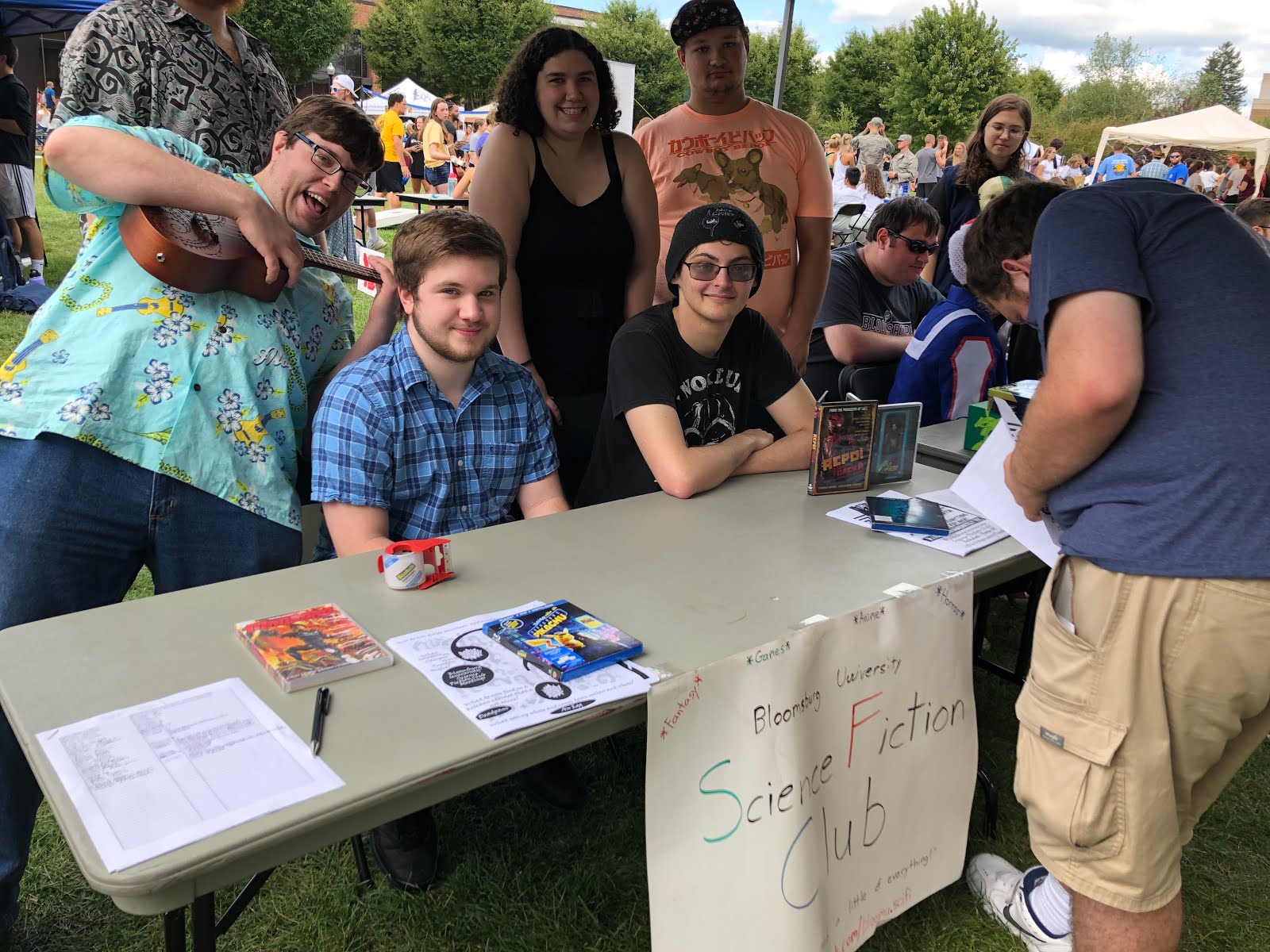
The Sci Fi club, having a blast (and apparently learning the ukulele);


Active Minds in health and wellness was so busy I could barely get a picture;


The LGBTQA table had FREE pride flags!


The Women’s Resource Center, perfectly posing;


And the whole fair!

Here's to the start of a great semester.


Saturday, December 8, 2018

Faculty News: WLN Online Edition

We are happy to announce that our WALES Director, Dr. Roggenbuck, is a co-editor for the WLN Digital Edited Collection, a journal for Writing Center Scholarship.  This digital collection is aimed at making this content even more accessible for writing centers around the globe. 


Interested in learning more about WLN and its scholarship?  You can check out their website here


Monday, November 26, 2018

Visiting WALES Before Finals

Hello, everyone!  With two more weeks of the semester left, many of you are likely working on multiple large writing projects for the final projects of your classes.  That being said, this is an excellent time to visit our writing center, WALES, and receive feedback and a helpful listening ear for any stage of your writing process!  You can visit WALES for:

  • Citation Styles
  • Grammar and Proofreading
  • Brainstorming
  • Evaluating Sources
  • And anything else you might need to review for a paper!
Additionally, do you have an ePortfolio due for an English class?  Every WALES consultant is versed in creating ePortfolios and can help you at any step of the process.  

We will hold sessions for more than just English papers as well!

Since this is the busy time of the semester, let me take the time to remind you that although we still accept walk-in appointments, due to the high volume of people requesting sessions it may be wise to book a session in advance.  You can do this by visiting our center to request an advance date, emailing us, or calling us.  Check out our website here for our email and hours.  

Good luck, and happy writing!

Wednesday, November 14, 2018

Meet our Students: Zachary Deretz

Q: Where are you from? 
Z: I'm from Baldwinsville, NY.

Q: What is your major? 
Z: I'm majoring in Secondary Education in the English Focus.

Q: What year are you? 
Z: I'm a Junior.

Q: What are some of your literary strengths?
Z: I am obviously a literary genius and perfect in all regards… All jokes aside, I like to consider myself as someone capable of an adequate level of analysis on new subject material relatively quickly; moreover, I am certainly capable of reading quickly and with ease. I would also say that, due to my fairly decent experience with the field, I am capable of writing readily accepted papers based on what is deemed “acceptable professional language” in the field of academia.

Q: Favorite books or shows?
Z: Almost any question that asks me what my favorite rendition or selection of subjects, objects, discussions, etc. are met with fierce difficulty. I believe myself to be someone that I identify as indecisive for many situations, unless I am in a situation that requires me to be decisive with consequences at hand (such as a work environment). With this in mind, there is no way I would be capable of choosing a single book that I find the most enjoyable. That is a feat that is simply impossible; however, how about as far as favorite shows are concerned? I might argue that some “older” shows such as Fringe, Chuck, or The Office might be my favorite television shows, and my favorite movie would have to be V for Vendetta.

Q: Why did you become an English Major?
Z: I was one of those people who never knew what they wanted to do with their lives until my senior year of high school, and even then it was relatively “wishy-washy.” During that time, I encountered my AP English teacher for the first time in a classroom setting. Simple as that. I say what he did and felt that it was something I could enjoy and really learn to love; moreover, I have always had a deep love for Literature since I was young, so I never saw any issues with that backing up my newly acquired goal.

Q: What is your favorite class you have ever taken? 
Z: I would definitely have to say that my favorite class that I have taken up to this point in time would be my Shakespeare class of my sophomore year attending Bloomsburg University. It was an extremely detailed class that truly made me feel as though I could delve into the knowledge and experiences of the past. The professor did a wonderful job and truly had a profound knowledge on all of the subject material.

But, a close second would also be my freshman year’s Dinosaur class. Admittedly, I’m a child at heart and love dinosaurs. And to be honest, I expected it to be easy, but it ended up being refreshingly difficult with an immense amount of diverse and intricate knowledge that gave me a newfound respect for paleontologists and those studying ancient history.

Q: What organizations are you part of?
Z: I am a part of a couple organizations, I suppose? I guess the most relevant to this interview would have to be the fact that I work at the Writing and Literacy Engagement Studio (WALES), formerly known as the writing center. It’s a great experience and has helped me in my field by leaps and bounds, so I definitely recommend people check it out. I also attend the Student Poetry Association (SPA) located on campus as a member; although, due to my schedule this semester I’m having difficulty making it to many of the meetings. Technically, there are a couple of other groups here and there, but I am more of an honorary member until my schedule eases up on me, so I won’t go into detail for those.

Q: What subjects do you like to write about, formally and informally?
Z: Sado-masochism. Now, I say that half jokingly, but I actually had a great formal writing experience in my aforementioned Renaissance class by debating the rhetorical connection between sado-masochistic theories and some others that I won’t go into detail due to time restraints. It really depends on the subject, timing, even how I feel that day, to be honest. I like to write about interesting and highly debatable topics that I have had time to truly think about and consider, especially when I get to combine theories and hypotheses.

As far as informal writing goes… I don’t tend to have to much time for that these days. But I guess my poetry tends to focus on loss and/or love? I tend to write Sonnets, so it tends to make more sense. Oh, I also like to write about nature, as I am a huge fan of the world’s natural beauty.

Oh… and let’s say potatoes too. I won’t explain any more than that. I think it’s more fun that way.

Q: Quick, create a title of a book you’d like to write!
Z: Rise of the Potato Cult: A True Story by myself, obviously. I jest, I jest… I would actually like to publish a collection of some of my poetry some day. Or not? Regardless, I’d probably title it something along the lines of My Not-So Final Verse.

Q: Now create the title of a book about you?
Z: Oh dear... I guess I’d title it something like… When is the Night I Slept Last: A Life With Minimal Sleep.

Q: Dream job: go!
Z: I would love to be a stay-at-home husband for a really wealthy woman… I say, again, half jokingly. I mean, there is a reason that I want to become and English teacher. I genuinely love to see people that come to me for help grow on their own and feel proud of themselves when they improve on the subject I helped out with.

Q: Any advice for incoming freshmen or students who are thinking about taking more English classes?
Z: I’d have to warn freshmen not to get discouraged. Often times, your high school teacher taught you something wrong when it comes to “correct” grammar and you’ve also almost never been taught how to think critically at the collegiate level, so don’t hesitate to ask questions, even if you think they might sound stupid.

Wednesday, October 24, 2018

Meet Our Professors: Dr. Roggenbuck

Q: Where are you from?
T: Originally, I grew up in North Dakota.  [I’ve spent] not quite ten years in Pennsylvania.

Q:Where did you graduate from?
T: I have four degrees.  I have an Associate’s in Liberal Arts from Minnesota.  I have a Bachelor’s from Portland State University in Oregon.  A Master’s from the University of North Dakota.  And a PhD from the University of Southern Mississippi.

Q: What kinds of publications have you written for?  
T: [Most recently I've been involved in editing for] WLN.  The full title is WLN: A Journal of Writing Centers.  Historically, it was known as the Writing Lab Newsletter. But, a few years ago they decided, looking at the nature of the work and the fact that it is peer reviewed, “newsletter” wasn’t really the way to describe it.  So, instead, we renamed it.  People in the field still refer to it as the Newsletter.

So, I’m a co-editor for that, which is a lot of work - good work.  I’m co-editing the digital edited collection [What We Teach Writing Tutors: A WLN Digital Edited Collection], which is the first of its kind in our field, which is very exciting.  Somebody published a book recently pointing to the problem that writing centers are - people are interested in writing centers around the world.  We had visitors from a college in China [last semester]; they got really interested in our center.  I recently saw a presentation about writing centers in China.  They’re emerging, and they’re emerging everywhere.  The problem is getting access to our scholarship.  People can’t  - they don’t have a subscription to JSTOR or can’t get to our scholarship.  So, WLN is nice in that our back issues are archived online after a year.  We’ve also created this digital edited collection, which is really pitched for a new director or, say, someone in a graduate program… everything you need to know about how to train and educate your writing tutors.

I’ve mainly written for writing centers… it’s been years since I published somewhere that wasn’t [for a writing center journal.]  The last that wasn’t for one was in a journal called Teaching Writing.

Q: How long have you taught at Bloomsburg?
T: I’m in my tenth year.

Q: What classes do you usually teach?
T: Basically, there are four classes I teach here.  I teach the introductory tutor class, English 297. That stays fairly consistent each year.  Of course, I teach sections of returning tutors, and we rotate that topic.  The two classes I get to teach for the English Department - I’m currently teaching the Theory in Practice in Writing class, and that’s a neat class… for one, the group of students in that class are future teachers of English.  We have one semester to correct a whole lot of misconceptions about what it means to teach writing.  The other class I get to teach is English Grammar and Usage.  That’s English 212.

Q: Involved in any other organizations, other than WALES?
T:  On BU campus, I am involved in several projects.  One is the Military Credit By Review committee, designed to help people with military experience get an accurate assessment of what credits [they should receive].  I’m on the university curricular committee.  So, we think about changes and grading curriculum across campus.  I’m involved in academic enrichment.  Just a lot of writing curriculum.  Oh, I’m involved in writing placement, so students can come here either starting in English 101 or in English Enrichment.

Q: What are your personal favorite kinds of books/shows?
T: I like comedy if I’m watching television. Anything with a laugh track, I probably won’t watch… But anything that is a little strange [I like]. I have the great fortune of being married to someone who reads voraciously, so I never even look for books.  I have the ones that are left for me to read.  Good literature.  Contemporary.  I’m reading An American Marriage right now.  [It’s a good way to pick up unfamiliar genres.] Absolutely, but I never - I was telling someone I was reading this great book this morning, and they asked me the title - I don’t even remember!  I don’t pay attention, because, you know, it’s just the book that was the next thing for me to read, and I didn’t seek it out.  It’s a great problem to have.

Q: If you could create your own class to teach, without restriction and about anything you want, what would it be?
T: That’s a tough question…  Well, there’s a way in which that I’m really troubled by where we are right now. I read an article yesterday about a group - it’s something like Invicta Europa.  It’s an alt-right group.  They’re a white nationalist group, and they’re kind of going undercover at places like CPAC, and their goal is to hide their ideology so they can infiltrate and get elected to GOP spots.  Then, when they have enough pull in the Republican Party due to their elected positions, they can start to try to… their fear is that by 2045 white people will not be the majority anymore.  They want to shut down non-European immigration as a way to combat, and they’re very much in lieu of President Trump’s policies.  So, any class that can help students actually process information carefully, and allow us - and I do think if we can be willing to think and hold disparate views at the same time, humans are decent enough that we can overcome groups like that.  So, if someone said “develop an important class” that would be it.  It would be a class designed to - not infuse my politics into students’ heads, but to force them to think.  I think those classes already exist, but that’s the work I'd think of.

Q: What is the best advice someone has ever given you about English?
T: I’d go back to my high school English teacher.  He wouldn’t probably have known what theoretical position he was coming from, but he was an Expressivist.  Every week - I had the same teacher from seventh grade through twelfth grade.  It was a small town.  Every week, we wrote what we called a 400-word composition.  Two double-spaced pages was essentially what we had to do.  I decided one time I wasn’t - I was just writing whatever... I had a very real rhetorical situation.  I wanted to entertain these people. So, every week, that’s what I was trying to do.

One week, I decided, well, I should do something more academic.  I went to the encyclopedias in the library and being somewhat of a lazy student, I only got to the “A” and stopped at Australian Flying Bats.  And I wrote an essay about Australian Flying Bats.  Mr. B always returned our reports regularly, but he didn’t turn it back that week.  He waited, and the next week I wrote something more like what I was usually writing.  Something about how cold it was in the house in the winter before you started the fire.  Just this descriptive nonfiction essay.  I made up stories about this cheese addict that managed a Pizza Hut.  You know, just whatever a high school kid is going to do.

So he took - in front of the whole class, and we’ve all known each other since we were young - he takes my Australian Bat essay, and as he’s handing back the essays, he crumbles [up my essay] and he throws it in the garbage can.  “Ted, this is awful!”  Then he hands me my cheese addict essay and says, “There’s the Ted we know.”  And I think that had a profound impact, just having a real person engaging through that.  So, I’ve never really been confused about writing what I’m interested in.

Q: Quick, create a title of a book you’d like to write or a book about you:
T: Weirdly, these titles come right into my head.  Unintended Consequences could work for both.  Why?  [laughs] So, if I’m writing about myself, I had no idea how I landed a job I love in a place I love.  It’s a little tough right now because, as America has kind of shown its racist face a lot more, I’m not as in love with living out in the country as I have been.  But, I still love the countryside.  But I had no idea - there were years I was trying to do other things.  My idea of - when I was eighteen, was join the military, learn how to operate nuclear power plants, move to France, where nuclear power is a big source of energy, live in France, operate a nuclear power plant.  That was the plan.  And then it just sort of kept changing, and changing, and changing along the way, to the point that even in my PhD program, I went as a creative writer. I still hadn’t figured out yet what I wanted to be.  But, things kind of keep happening, in a way I really hadn’t known or guessed.  Eventually, you start to aim a little bit.  You decide to go on the market and apply for a job like this. I almost had to be hit on the head before I realized that this is where I should be.

Q: What would you like to see for the English department? 
T: We know how valuable the work we have students do is, but we keep shrinking.  We’re down several professors, and I think it’s because it’s very hard to convince people’s parents that it’s okay to be an English major because it doesn't seem immediately practical.  Now, all of those ‘soft skills’ English majors develop - and what research shows us about liberal arts - they bring all these skills and abilities.  So...again, if people were ready to think in more complicated ways, to understand the value of a liberal arts education, it wouldn’t be such a hard sell.  This is a wonderful English department.  I’ve been in many English departments before I got here, and two of them were not very functional.  In fact, one had to do something called “receivership” where an outside person came in and was the chair.  They fought so much.  Our department doesn’t really have that problem.

It would be nice to get more people in here and help us continue to move into the 21st century. I don’t know - there are some of our classes that can be taught well online, and some that I struggle to imagine having the same impact in an online environment.  I could teach English 212 [English Grammar and Usage] online, and that could work.  But, I would struggle to teach English 306 online.  Being in the room for the conversation matters, especially for future teachers.  I think that’s probably similar for some literature classes. Conversations within the classroom have a lot of power.  I’m not against an online environment… but I know what a special experience it can be [in the classroom].

One thing I also think - rather than sort of revering, I think we should respect and present our students literature throughout the history of the world, western European and world literature, and underrepresented cultures' literature.  But - the thing that happened to me, and thank goodness the person I’m married to escaped it, but when I was an undergraduate, I don’t know that I was assigned to read anything that had been written within the last 30 years.  It was all older stuff that I was reading.  Again, that was a long time ago, so maybe it’s changed… well, that’s not true.  In my creative writing courses, I read more recent stuff.  In my literature classes, I didn’t.  It was all anthologized stuff.  There wasn’t really a contemporary literature niche.  And so, I think one thing - I’d love our literature folks to leave here knowing how to find good contemporary literature.  I don’t know if we have as much of that as we should.  I would love for all BU undergrads to leave here knowing how to find literature that mattered to them, because there’s lots of great things being written and published, and I’m not sure if we’re equipping our students to have lives as readers of stuff that’s current.

Thanks to Dr. Roggenbuck for the interview!

Wednesday, September 26, 2018

Meet Our Students: Julia Bagnata

Q: Where are you from?
J: I am originally from a small town called Rock Glen - but I moved to Bloomsburg at least ten years ago, and I’ve been living here ever since.

Q: What is your major/minor?
J: Mass Communications on the journalism track, and English as a second major on the Digital Rhetoric and Professional Writing track.  I thought about a minor, but I don’t know if I have the time for a minor!  I wish I did, because there’s so many things that interest me that I would love to study more.

Q:  What year are you?
J: A sophomore.

Q: What are your literary strengths?
J: I prefer - it takes me a little bit to analyze reading, so I prefer to write, especially creative things or those that don’t require a lot of outside research.  I wish I had more time to do creative writing because I do enjoy that in my free time.  Although, once I figure out the focus for a paper, I get it done in good time.  It’s just the research process that takes forever.  [laughs] I guess that’s my weakness as well.

Q: What do you like about being an English major?
J: I do enjoy helping other people [in WALES] enjoy and understand writing.  I like brainstorming the most, I think -  helping students come up with ideas.  I love seeing a student, when they come in, go from being confused and maybe stressed to helping them develop great ideas.

Q: What are your favorite books/tv shows/genres?
J: As far as tv shows go, I recently started watching BoJack Horseman on Netflix - which was a mistake because now I’m binge watching all of it.  Most of the shows I watch are those kind of dark comedies that are funny, and then at the very end of the episode it says something serious.  I don’t know why I’ve been watching those kinds of shows lately.  Maybe because I relate - [laughs] because I try to cope with humor.

Q: Why did you become an English Major?
J:  I started as an Education major. I was in education - English education - and I did that when I was coming out of high school because I enjoyed the writing process and creating my own work so much, but you’re always told in high school that you can’t really get a job ‘doing English.’ So, I just assumed that my way to do that would be to become a teacher.  As I took education classes I realized it wasn’t really going to be for me, because the reason I enjoy English so much is that I have the ability to create new things, and in the future - now I have more flexibility in what I can actually do as a job.  If I get tired at one profession, I can switch.

Q: What was your favorite class that you’ve taken so far?
J: I actually really enjoyed English 397 (the WALES class) last semester with Mr. Koch, for the reason that it forced me to learn better habits, especially with grammar.  I don’t want to say I was lazy, but I was lazy before that because, prior to that class I could kinda get by without doing the best I could do because I was able to do it.  I just didn’t put in the effort 100% of the time.  That class made me take apart how I write. It made me write totally differently and for the better.  Even though it was very difficult, and very stressful, I would say now that it’s done I definitely am very happy that I went through it.

Q: What organizations are you part of?
J: I am part of WALES, as we’ve discussed, and I am a news editor for the Voice. I joined that last semester.  I am also the president of the Society of Professional Journalists, so I have a mix of English and Mass Comm in my extracurricular activities. They keep me busy.

Q: What do you like to write about?
J: As far as academic writing, my favorite type of papers - I would say I do enjoy analysis essays because they make me look at [writing more closely].  It’s a challenge.  Today I took my rough draft of a poem explication - I took it to [my professor] and she said I have the skeleton of a good paper, so I went back, reread, and doubled the length of it. Things like that - because I forget sometimes that you take classes to learn.  I feel like a lot of people feel like if they don’t go into a class and they know everything that’s going on, they feel stupid.  But you do take classes to learn and be challenged.

Informally, when I do creative writing… I like to think I have a sense of humor.  I’ll write really serious poems, but really just sort of mocking the genre, if that makes sense - like, in my senior year of high school... we had to write a very serious poem about loss and make a deeper statement about this and that, and I wrote about a dead goldfish.  You think it’s going to be serious and it’s really not entirely.  I think that ties back to the genres I like.

Q: What’s the title of a book you’d like to write?
J: I’d probably write something about how to cope with [laughs] being a mess.  It’d be called, like, Take My Shovel: I’ve Dug Myself too Deep or something like that.  No, um, I guess that’d be more of the title of a book about me.  But it could be a memoir.  I can combine them.

Q: Dream job?
J: I would like to work some day for a publishing company for editing, working with authors on books, because while I do love to create my own, I think - more so - I’d be happier not having the pressure of creating all the time but still being able to work with the writing, kind of picking it apart and seeing what’s good and what needs to be redone.

Q: Any advice for new English students or anyone who was in a situation where they didn’t like what they were doing and were thinking about taking English classes?
J: I would say - you know what? A lot of people told me I need to think things through very carefully, but I think with my major change situation - if someone is in a similar situation to me - I just woke up one day and had this epiphany that I’m not happy.  That day I went to the office and filled out the form and changed my major.  As simple as that.  And I started to panic after that because I thought I’d made the decision too quickly, but now I’ve become part of all these organizations, and I’ve got this great job at the writing center, so I’m happy.  I think if I had thought it through more and put it off and took another semester of classes I didn’t actually enjoy, I would have been even more unhappy.  You’ve got to go for it.

Thanks for the interview, Julia!

Monday, September 17, 2018

The Writing and Literacy Engagement Studio

The Writing and Literacy Engagement Studio, also known as WALES, is Bloomsburg University's student resource for aid with writing projects across disciplines.  Students from any major and in any point in their career may come to the studio for help.  All of the consultants are undergraduate students as well!

WALES can help writers at any point of the writing process, from brainstorming to citations to final proofreading.  These papers are not limited to English essays but can include resumes, applications, creative writing, and papers from any discipline.  Similarly, the consultants can help work on reading strategies and comprehension in order to gain skills that can be applied across disciplines.

This is a 100% confidential service provided through the university, and we are free to use!

Q: What if I'm not sure what I need help with?
A: Not a problem!  You and the consultant can sit down, review the topic and/or paper together, and go from there.  Conversely, you can have a specific agenda that you want to cover during your session.

Q: Can I drop my paper off any pick it up later?
A: Unfortunately, no.  The WALES process requires that you sit down with a consultant and look at the paper together.  This is not a proofreading service but an experience that will hopefully lead to stronger writing skills.

Q: How long are the sessions?
A: You are allowed one hour per day.  The session may not take up to the whole hour, depending on what you work on.

Q: How do I schedule an appointment?
A:There are several ways to make an appointment.  You may simply walk into one of our locations and request a session in advance.  You can also email us at wales@bloomu.edu or call us at 570-389-5232.  We do accept walk-in appointments, but setting up one in advance is advised.

Additionally, we offer online appointments as well, although 24-hour notice is needed.  WALES uses a screen-sharing program called Zoom that allows the consultant to see your paper.

Q: Where is WALES located on campus?
Bakeless 206: Monday through Thursday from 9:00 am -7:00 pm; Friday from 9:00 am - 4:00 pm

Andruss Library Schweiker Room: Sunday through Thursday from 7 pm - 9 pm

Elwell Lobby: Sunday through Thursday from 9 pm - 11 pm

Have any questions?  Stop by Bakeless 206 or contact us via email or phone.  Our locations and hours are also posted on our Bloomsburg University page.  We hope to see you there!


Congratulations Are In Order: Student Writing Contest

We are excited to share a snapshot of the judge's comments from this year's Student Writing Contest. The English Department is treme...